
A year ago, most of the conversation about coding agents was about the model. Which one writes better code, which one reasons longer, which one tops the benchmark this week.
That conversation has quietly moved. The model is rarely the thing that breaks now. What breaks is everything around it: what the agent was told, what it was allowed to touch, what it decided on its own, and whether anyone can explain afterwards why it did what it did.
As rkito’s founder, I’ve spent most of this year looking at how teams actually run agents across organizations. Here’s my honest read on where things stand, what’s working, what isn’t, and what we’re building at rkito because of it.
What’s actually emerging
Strip away the product names and you find a handful of ideas that keep showing up.
Write the intent down first. Spec-driven development is the loudest of these. GitHub’s Spec Kit gives you a fixed sequence: a project constitution, then specify, plan, tasks, implement. Each step leaves a Markdown file behind that feeds the next one. Kiro, OpenSpec, Tessl and BMAD-METHOD are variations on the same bet: the spec is the thing you review, and the code follows from it. Even GitHub calls Spec Kit an experiment, which I appreciate.
Put the rules where the agent will read them. AGENTS.md has become the default place to tell an agent how a repo works. It now sits under the Linux Foundation’s Agentic AI Foundation, next to MCP. Agent Skills (SKILL.md) go a step further and package a procedure the agent loads only when it needs it. Claude Code, Cursor and GitHub Copilot all read them.
Agree on the plumbing. MCP connects agents to tools and data. A2A connects agents to each other. Zed’s Agent Client Protocol connects editors to agents. None of this is glamorous, and all of it matters.
Context engineering, and now the harness. People stopped talking about prompts and started talking about context: what the agent knows at the moment it decides. The newer word is harness. One writer at Ant Group put the split neatly: context engineering looks after the quality of what goes in, harness engineering looks after how disciplined the execution is. The harness is the set of permissions, limits and checks that decide what the agent can touch and what happens when it gets stuck.
Teams of agents. Plan mode, subagents, background agents, several agents working in parallel on separate branches. Anthropic’s 2026 trends report expects organisations to run coordinated groups of agents, and describes the development lifecycle as “flattened” rather than replaced.
Watching what they do. OpenTelemetry is building a shared vocabulary for agent traces: model calls, tool calls, agent runs. As of this autumn it’s still marked as in development.
The good part
I’ll start here, because there’s a lot to like.
Intent is becoming a real artifact again. For years we wrote specs to get agreement, then let them rot the week coding started. Spec-driven development makes the spec the input, so it has to stay true. That’s a healthier habit than most of us had before agents showed up.
Rules are finally portable. Before AGENTS.md and Agent Skills, every tool had its own rules file and its own format. Now one file can be read by many agents. That alone saves teams a surprising amount of duplicated effort.
The plumbing is open. MCP, A2A and the agent client protocol all sit under neutral foundations or open specs. I don’t have to bet the company on one vendor’s agent to get tools connected.
People are being honest about reliability. The interesting work this year isn’t bigger models. It’s deterministic guardrails, evals and tracing, the boring things that make agents behave the same way twice. Salesforce’s trend list for 2026 is almost entirely about that.
The economics are real. Teams are shipping in hours what used to take days. Engineers spend more time deciding what to build and reviewing what came back, and less time typing. Most of the people I talk to don’t want to go back.
The bad part
Now the uncomfortable bit.
More context isn’t better context. ETH Zurich tested whether AGENTS.md files actually help. Files generated by an LLM made agents slightly worse on average. Hand-written ones helped by about 4 percentage points. Every kind of context file pushed inference cost up by roughly 20%. The agents weren’t ignoring the files. They were following them too faithfully, including the lines that didn’t matter. The lesson isn’t “don’t write context files”. It’s that context needs to be short, relevant to the task, and earned.
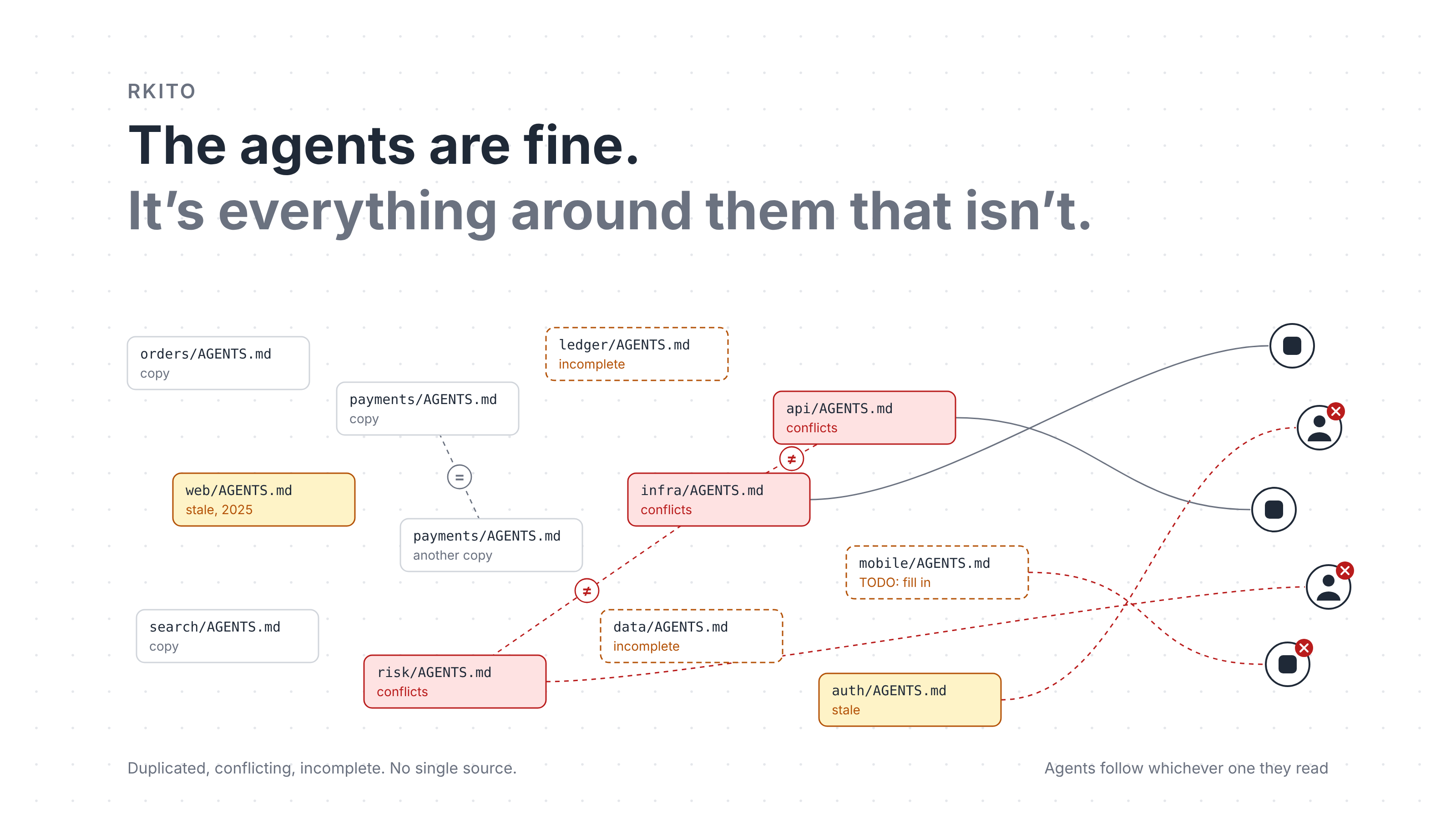
Everything stops at the repo boundary. A Spec Kit constitution lives in one repository. So does AGENTS.md. Your enterprise doesn’t. The rule that says “payments data never leaves the region” was decided once, by an architecture board, for forty repos. Today it gets copied by hand into forty files, drifts in thirty of them, and nobody notices until an incident.
Skills are a new supply chain, and it’s already being attacked. Snyk audited almost 4,000 public agent skills in February and found critical issues in 13.4% of them. The ClawHavoc campaign planted 341 malicious skills in one registry, and the count kept climbing. A skill isn’t a passive document. The agent reads it as instructions and acts with its full permissions.
Dashboards don’t stop anything. One 2026 study found that governance by dashboard alone prevented only about 27% of policy violations. Watching isn’t the same as steering.
The traces can’t answer the auditor’s question. OpenTelemetry can tell you an agent called a tool. It has no standard way to say whether that call was allowed by policy, approved by a person, or kept within a stated scope. That’s exactly what a regulator will ask.
Nobody is measuring whether the rules work. We count lint failures at the pull request. We almost never ask whether a policy changed what an agent proposed in the first place, whether that led to a good decision, or whether it quietly created tech debt three months later. AI-written tech debt is already turning up in engineering postmortems.
Code review is being dropped, not redesigned. Engineering leaders are splitting into two camps. Some are under so much pressure for speed that teams merge agent code with no review at all, or hand review to another agent that has no better context than the one that wrote the code. It will miss the same things for the same reasons. Others insist on a human reading every change, and they’re right to be careful. But they can’t scale their best reviewers to match what agents produce. Both camps miss the same point: how much a broken release costs isn’t the same everywhere. A social app can live with an hour of a broken feature. A bank, an insurer or a supermarket can’t. Throwing out peer review goes against most of what software engineering has learned, and doing it before we’ve done any real context engineering is a serious mistake.
What we’re doing about it at rkito
We started rkito with a simple belief: the enterprise of the future will have more agents than engineers, and those agents will need the same thing new engineers need. They need to know what the organisation has already decided, and someone has to hold them to it. So we’re building one place where that intent lives, and making it reach the agent at the moment it matters.
One source of intent, above the repo. rkito keeps the organisation’s decisions in three connected ledgers. The Steering Ledger holds vision, policies, best practices and compliance controls. The Architecture Ledger holds ADRs and tech debt. The Code Ledger is what actually shipped. Every rule is broken into clauses with their own address, like POL-18#3. Each one says where it came from (a vision, a steering decision, an ADR) and where it applies (the whole org, a domain, a product, a team or a process). Write a rule once, at the right level, and every repo in scope inherits it. No copying into forty files.
Context that’s queried for the action taken and not dumped. This is our answer to the AGENTS.md problem. When an agent or a person working with agents asks rkito to validate an intent over MCP, we don’t hand back a wall of guidance. We work out which clauses actually apply to that change, in that scope, and return only those, along with the options they shape. Less to read, and every line is there for a reason. If a repo still wants a constitution or an AGENTS.md file, we can generate it from the ledger for that scope, so it never drifts from what was decided.
A harness the enterprise owns. The same clauses that shape the options at design time become checks at the pull request. That’s the difference between a dashboard and a rail: one watches, the other actually sits in the path. And because rules are reviewed and approved in the ledger, with an owner and a history, they don’t arrive from an anonymous skill on a public registry.
Review that scales with risk. Review depth should follow blast radius, not fall to zero everywhere. Each organisation sets its risk tier per domain in the Steering Ledger, so a payments path and a marketing page don’t get the same treatment. An agent reviewer gets the same scoped clauses the authoring agent saw, so when it misses something, you can trace the miss to a rule. People move up a level: they own the rules and review the high-tier changes, instead of reading every pull request. And because every gate is traced, you can see where agent and human reviewers disagree, and which clauses catch real defects.
Traces that answer the auditor. Every time a clause is retrieved, shapes an answer, leads to a decision or gates a change, rkito records it against that clause’s address. When someone asks “was this allowed, and by what?”, the answer is a link, not an archaeology project.
Measuring whether rules work. This is the part I’m proudest of. For each policy we follow its reach through a chain: retrieved, influenced, decided, gated, and finally the outcome. We split it by fully autonomous agents, people working with agents, and people on their own. We tie it to the ADRs it led to, the tech debt it prevented or created, and the change items that broke it. Every cost figure shows how it was calculated and where the inputs came from. Leaders can see which policies are earning their keep and which are just noise, and retire the noise. Fewer, better rules is also how you keep agent context lean.
Everyone sees it from where they sit. An executive sees risk and cost avoided. A domain architect sees which part of the landscape keeps tripping which clause. An engineer sees why their agent suggested what it did. Same facts, different views.
None of this replaces Spec Kit, AGENTS.md or MCP. We use them. What we’re adding is the layer above them, so an organisation’s judgement scales as fast as its agents do. If that’s a problem you’re feeling, I’d love to talk.
References
- GitHub, Spec Kit repository
- Plannotator, GitHub Spec Kit framework profile (reviewed July 2026)
- Xebia, From Spec to Code: Building Software with Spec Kit (June 2026)
- CodeMySpec, GitHub Spec Kit: How It Works and When to Use It
- Gloaguen et al., ETH Zurich, Evaluating AGENTS.md: Are Repository-Level Context Files Helpful for Coding Agents? (February 2026)
- InfoQ, New Research Reassesses the Value of AGENTS.md Files for AI Coding (March 2026)
- Addy Osmani, Stop Using /init for AGENTS.md
- Snyk, ToxicSkills: Malicious AI Agent Skills on ClawHub (February 2026)
- Snyk, From SKILL.md to Shell Access in Three Lines of Markdown
- Daniel Vaughan, The Agent Skill Supply Chain Crisis (June 2026)
- Anthropic, 2026 Agentic Coding Trends Report
- Salesforce, 8 Ways AI Agents Are Evolving in 2026
- Ant Group, The Agentic Landscape in 2026 Q1
- Dash0, OpenTelemetry GenAI Semantic Conventions Explained (September 2026)
- TinyFish, The OTel GenAI Spec Has an Implicit Reader
- DEV Community, AI Coding Agents in 2026: A Fullstack Engineer’s Recap